Folding up the benches is awkward and difficult. Gas springs offer a solution. Here, we first describe how to improve the small seating area, followed by the approach to the bed—including the slatted base that Eriba designed poorly.
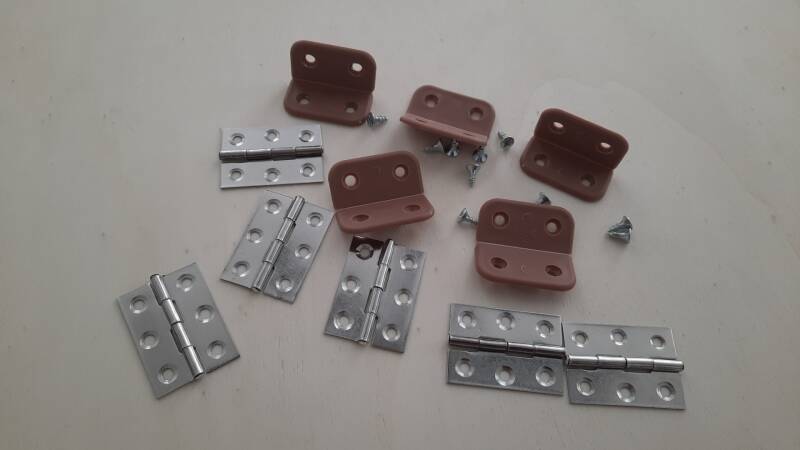
Front seating area. First, those plastic "hinges." These are the brown plastic flaps in the photo. So Eriba supplies a caravan costing almost 40 grand and uses these "hinges"?
In the same photo are the replacement stainless steel hinges we paid €2.45 for in China. Note: for ten pieces. So we're replacing the five inferior Eriba flaps with six stainless steel hinges, which also have the added benefit of allowing for more screws.
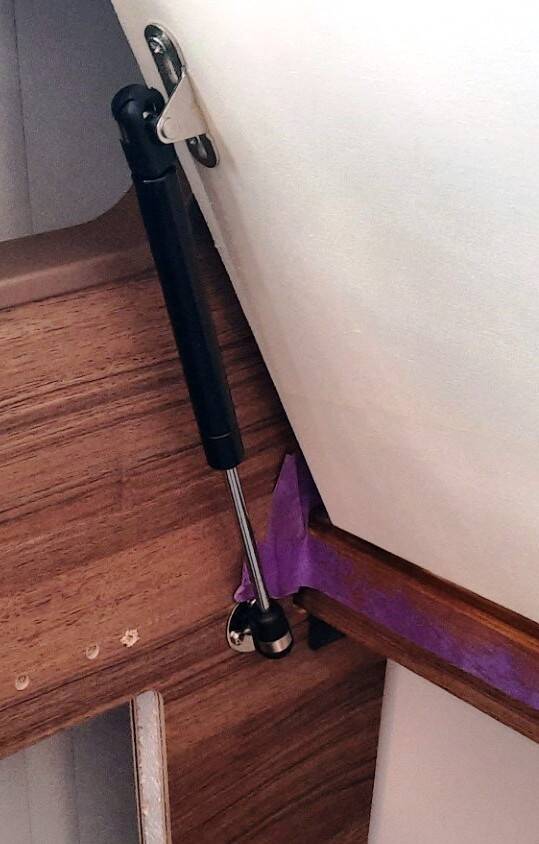
A quick test (photo left) shows that each bench in the small seating area requires two gas springs of approximately 60N.
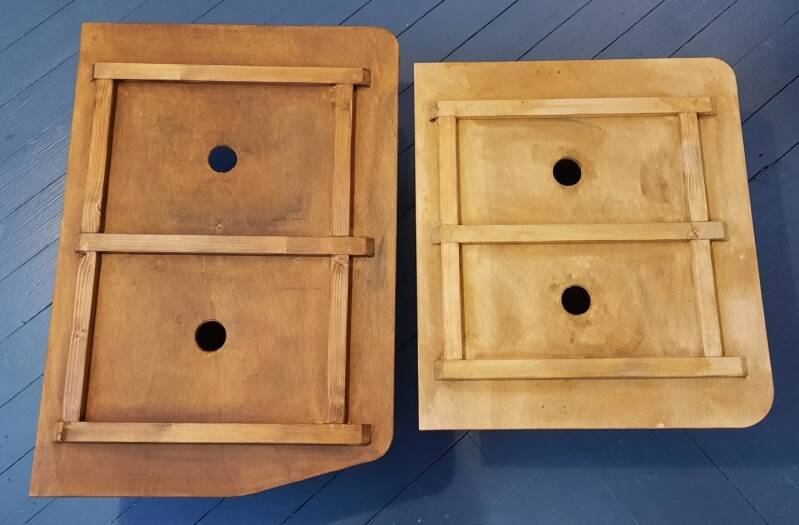
We reinforce the seats underneath with wooden beams and make a few holes for ventilation.
Photo right: the seats are painted with four layers of paint. You could also replace them by thicker wood.

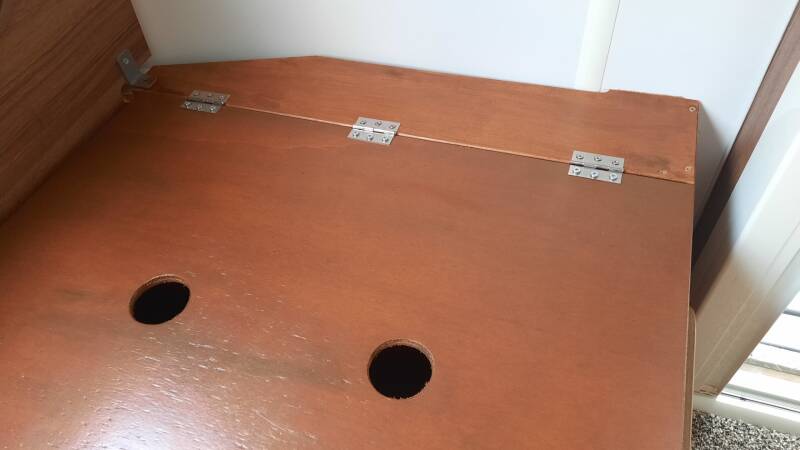
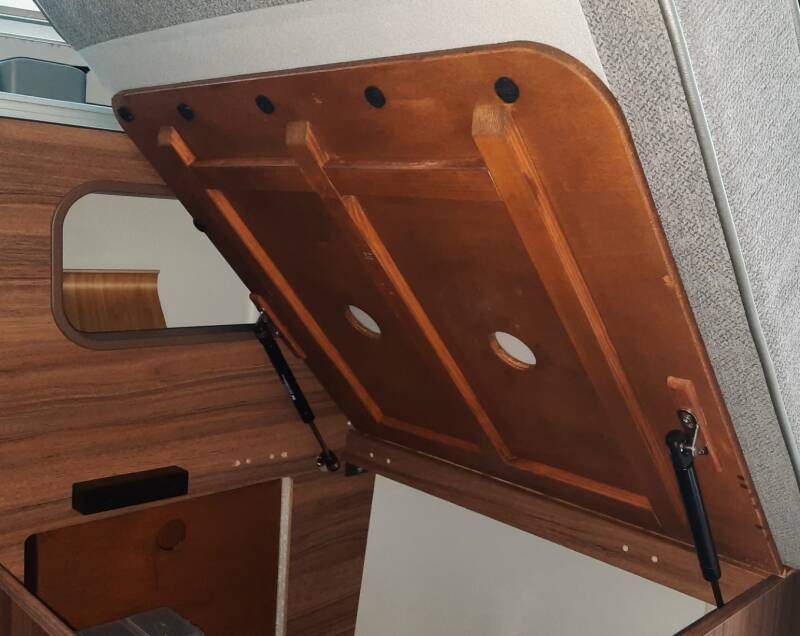
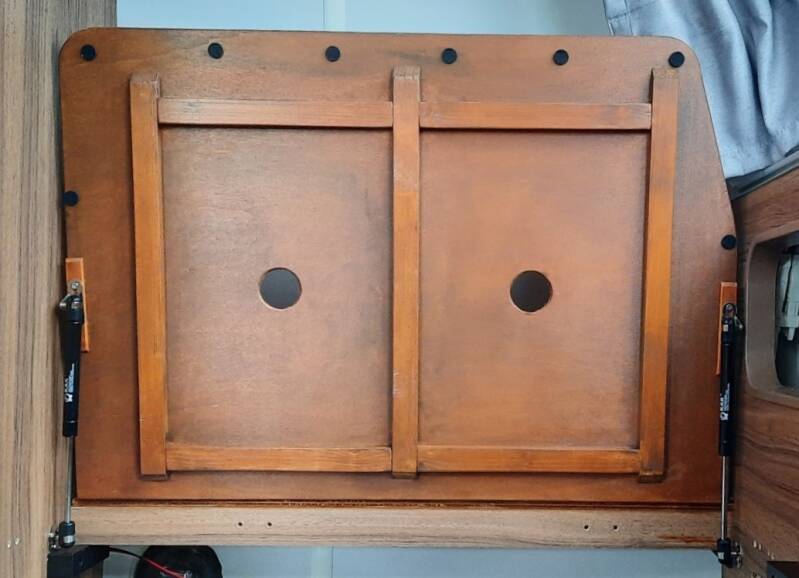
Result. We replaced Eriba's plastic flaps with the stainless steel hinges, reinforced and painted the seats, and added gas springs so the seats, including the cushions, remain open.
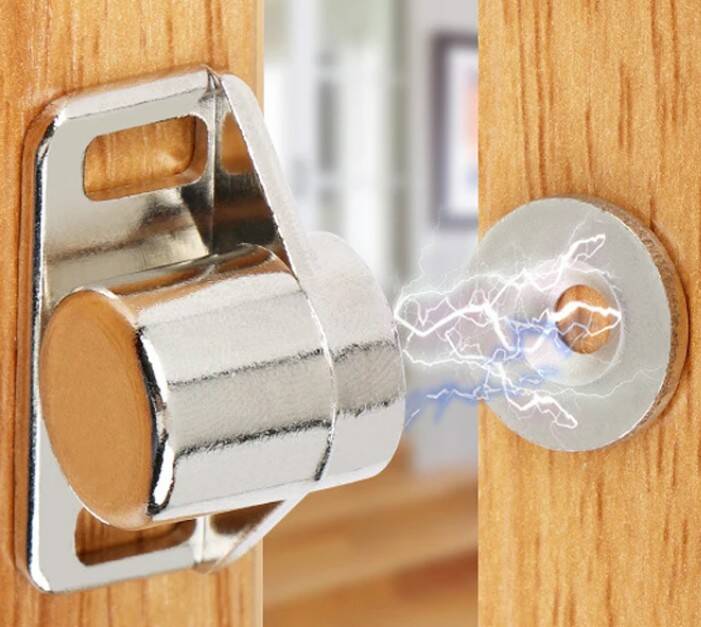
The downside of gas springs is that they can bounce open while moving. Therefore, we added magnetic closures. The black circles under the seat are soft pads to cushion the slamming motion.
Bed benches
After the small seating area in the front, it's time for the bed benches. We bought an "extra comfortable bed with a slatted base and spring mattresses". (Extra charge 675 euro.) It's clear that this construction isn't standard, but was added as an option afterward. A) The hinges are attached to a unstable, twisted plywood strip. (Ideally, you should rip out that flimsy strip and replace it with solid wood.) B) The bed bases, that also have to support heavy mattresses, are "screwed" in place with thin, 12mm-long screws. Who comes up with this? C) The slatted base is poorly designed, causing you to sag to one side in bed.
And now, the solutions for A, B, and C. If we could have kept our caravan at home, we would have ripped out that whole rickety bed-base assembly and replaced it with a design of our own. But since we have to do everything "on the road," we opted to reinforce each part individually.
A) We secure everything with extra angle brackets. Furthermore, an aluminum L-profile has been screwed onto the top along the entire length to make it more rigid. Once the construction is rigid, you can start thinking about gas springs. See the photos below. Motto: if there's an option for adding angle brackets, install them!
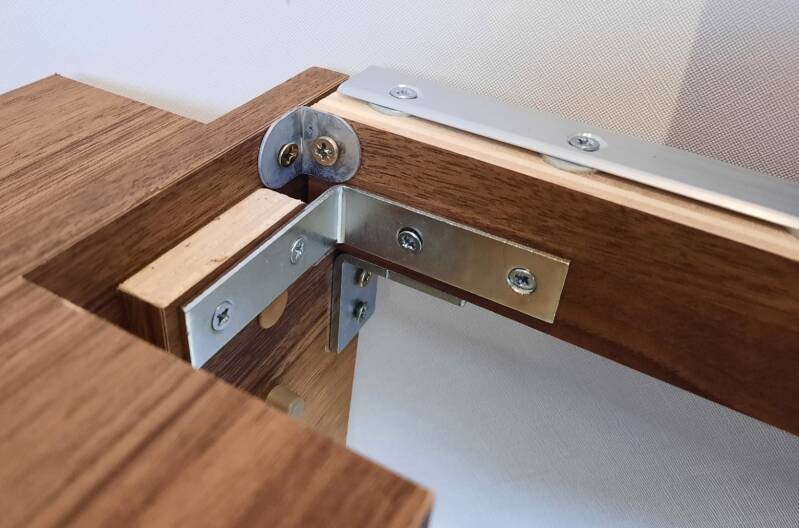
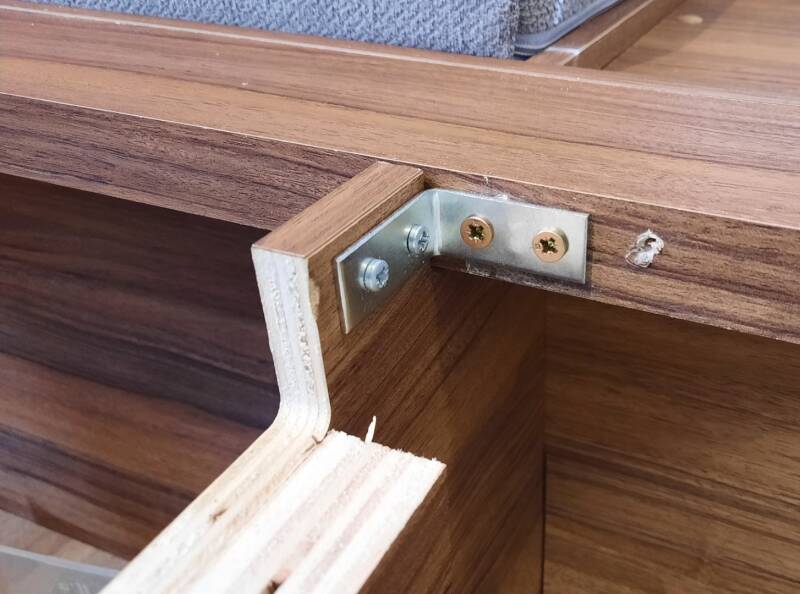
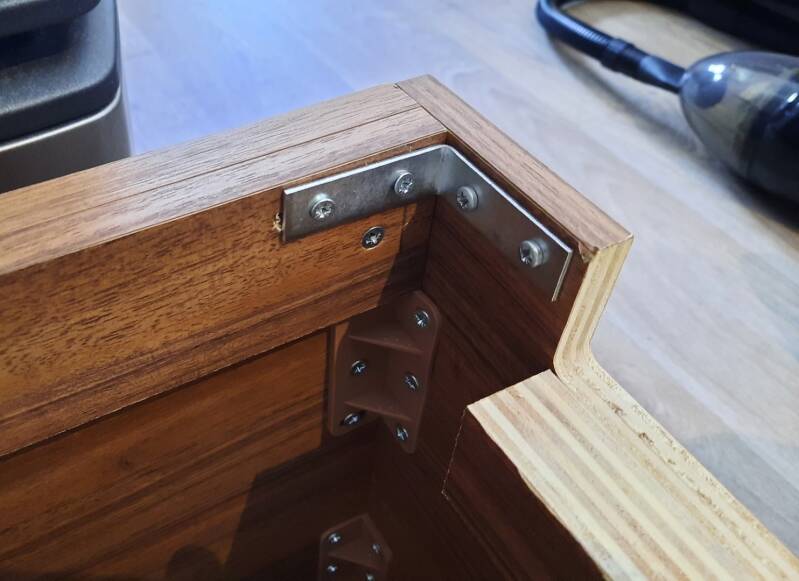
Below is a photo showing the various reinforcements. The extra strip running the entire length of the rear "beam" where the hinges are attached is not visible; it's on the top. This strip prevents twisting.
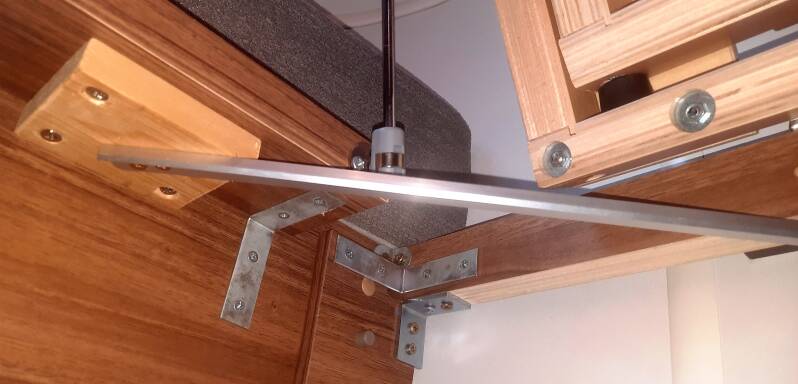
B) The "tiny screw disease". The use of minuscule screws isn't limited to Eriba's cabinet doors and bathroom fittings. The hinges on the slatted bed bases are also mounted in a shameful manner: you can practically pull the screws right out of the soft wood. Upon delivery, the bed was already crooked on both sides. Solution: replacing all of Eriba's screws with proper ones, and swap the ones at the slatted bases for M4 nuts and bolts.
C) The slatted bed bases. That is a story in itself. Let’s take a close look at the construction of the extendable bed base. What is going wrong here? There is a major design flaw in the Eriba concept. MORE TO FOLLOW
Commentes and questions:
Lieke&Leo: How strong are the gas springs you used? Answer: The gas springs under the small front benches are two times 60N. The gas springs under the bed benches (the ones with slatted bases) are two times 200N. But again: first reinforce the entire structure of all the benches before installing gas springs.
AndyCappy: Those "hinges" from Eriba are a disgrace. "Made in Germany" used to be a quality mark? Answer: Those were the days.
Leonore: Why is there also an aluminum (?) strip at a 45-degree angle in the last photo? Answer: That strip goes exactly to the hinge of the bed base on the right side. (It's not clearly visible in the photo.) It is indeed just aluminum and prevents the back (where a plastic block is mounted) from coming loose from the caravan wall. Because if you don't do this, the entire bed base will move forward on its own.
Maak jouw eigen website met JouwWeb